Guide
Buying Kitchen Cabinets: Stock, Semi-Custom, Custom and Refacing
Cabinetry is roughly two fifths of a kitchen budget, which makes it the decision that moves the total more than any other. It is also the decision most people make last, after the countertop has already been chosen from a photograph.
Fixr's January 2026 breakdown puts cabinetry at 40 percent of a typical kitchen budget. Nothing else on the list comes close: flooring is 18 percent, countertops 14, appliances 6. If you want to change what a kitchen costs, this is the lever.
The four options, and what separates them
Refacing
Doors, drawer fronts, hardware and visible end panels are replaced, and a veneer or laminate skin goes over the face frames. The boxes stay exactly where they are. Fixr puts it at $2,500 to $6,500 for a kitchen as of January 2026.
The test is simple: is what bothers you the surface or the arrangement? Refacing fixes the first completely and preserves the second exactly. If the layout is wrong, if you want drawers where there are currently base cabinets with doors, or if the carcasses are particleboard that has swelled at the sink, refacing preserves the problem you were trying to solve. On the eastern Chula Vista housing built through the 2000s, where builder cabinetry is often structurally sound but tired, it is a competitive option rather than a compromise.
Stock
$100 to $300 per linear foot installed, per Fixr January 2026. Fixed widths from a catalogue, usually in three-inch increments, in a set list of finishes, with filler strips closing whatever gap is left at the wall. Quick to get because it is pulled from a warehouse rather than manufactured to order.
Stock works well on a straightforward rectangular kitchen with square corners and standard ceiling heights. It struggles where the room has character, because character in a kitchen usually means something that does not divide evenly by three inches.
Semi-custom
$150 to $650 per linear foot. Same manufacturer catalogue as stock, but with depth, height, finish and interior configuration variable, so a run can be built to the wall rather than filled to it. This is the tier most rooms with a soffit, a bulkhead, an out-of-square corner, or a run that has to end at a window need.
On a plain rectangular kitchen the difference from stock is largely cosmetic. On a kitchen with a real constraint, it is the difference between an installation that looks built and one that looks improvised.
Custom
$500 to $1,200 per linear foot. Drawn for the room and built to it, with no catalogue constraint on dimension, finish or construction. The right answer where ceilings are unusual, where the layout has a genuine geometric problem, or where the budget is large enough that the marginal cost is not the deciding factor.
How to read a cabinet quote
Two quotes for the same door style routinely differ by thousands, and the difference is almost never the door. Ask for these in writing:
- Box material and construction. Plywood versus particleboard carcass, and whether the back panel is a full panel or a thin sheet with hanging rails. This is the part you will never see and the part that determines how long the cabinet lasts.
- Drawer construction. Dovetailed solid wood boxes against stapled composite, and whether the glides are full-extension undermount with soft close or side-mounted three-quarter extension.
- Hinges. Concealed adjustable hinges with soft close are the working standard. Non-adjustable hinges make a cabinet that goes slightly out of alignment permanently out of alignment.
- Finish. A factory catalysed finish and a shop-sprayed finish behave differently over ten years, and painted finishes chip at edges where stained wood hides it.
- What the linear foot includes. Some quotes count base and wall cabinets together in the figure and some do not. This is the most common apples-to-oranges comparison in the whole category.
- Interior fittings. Pull-outs, corner solutions, drawer banks, bin cabinets and lazy susans have to be specified at order, not added later.
Fittings worth paying for
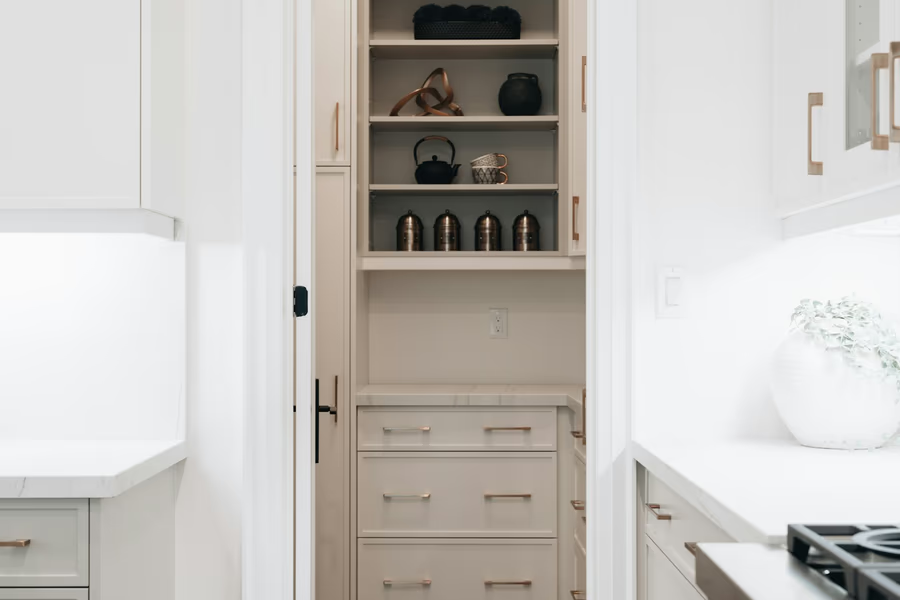
- Drawers instead of base cabinet doors. The single change that most improves daily use. A base cabinet with a door requires kneeling and reaching; a deep drawer brings its contents to you.
- A corner solution. A corner base cabinet without a pull-out or a rotating shelf is largely wasted volume, and it cannot be fixed after installation.
- A bin cabinet. Pull-out waste and recycling under the sink run or beside it, which is the alternative to a bin standing in the middle of the floor.
- Full-height cabinetry. Where a soffit currently stops the run short, removing it and going to the ceiling recovers real storage. Check what is inside the soffit first, because ducts and vent stacks do live in some of them.
Painted or stained
The NKBA reported in its 2026 kitchen trends survey, based on 634 industry professionals across North America, that wood grain has overtaken painted finishes in popularity, with 59 percent naming it as growing and white oak the most cited species at 51 percent. That is a trade survey rather than a homeowner survey, so read it as where the industry is heading rather than what every household wants.
Practically: painted finishes show chips at the edges and corners where a stained finish hides them, and stained wood shows grain variation between doors, which some people want and others find distracting. Neither is meaningfully more durable over the life of a kitchen.
Lead times set your calendar
Stock cabinetry can be on site within a few weeks because it exists already. Semi-custom and custom are manufactured after the order is placed, and those lead times, not the trades, determine when a kitchen finishes. The practical consequence is that the cabinet order has to be final before demolition begins, and any change after the order is placed resets the clock. The timeline guide maps how that plays out week by week.
Getting it priced
Ask for the same kitchen quoted in two tiers. Seeing stock and semi-custom side by side for your actual room, with your actual fittings, makes the decision concrete in a way that a per-linear-foot range never does. The cost calculator gives you a bracket to start from, and the cabinet service page covers what the installation involves.
For a real number, call (619) 754-4257 or use the quote form for a free quote.
Want this priced for your kitchen?
Ring (619) 754-4257, or send the quote form and somebody will ring you. Free either way.